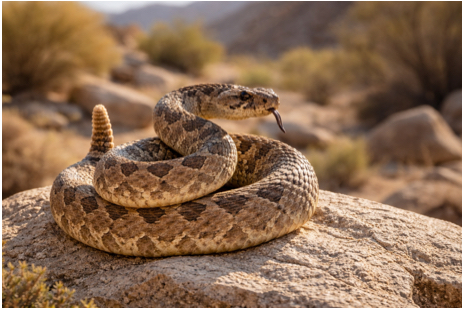
The rattlesnake, the elephant, and the baby. They have a basic problem in common: staying warm. Or at least, warm enough. They have very similar metabolic systems, which provide heat and energy. But they also have differences when it comes to managing to stay warm.
We human animals have both heating and cooling systems. The complex, interconnected, pathways of metabolism generate the heat we need. If the rate of metabolism is too high — maybe we’re running a marathon — cooling mechanisms kick in; the blood is redirected more to circulate near the skin, we sweat, we pour water over our heads.
Basic Energy Metabolism 101
Metabolism, which consists of thousands of interconnected chemical reactions, produces heat. It’s in the nature of chemical reactions, whether in a biological system or a test tube. What produces heat in metabolic reactions is their ‘inefficiency’. A chemical reaction close to equilibrium produces very little heat, and runs relatively slowly. (At equilibrium, of course, everything stops.) The metabolic reactions in the body need to go at an appropriate speed, which means that the reactants and products are usually not near equilibrium. Under those conditions, they generate heat. Heat is the price of getting metabolism to run at a reasonable speed, which is important for metabolism to keep us from the equilibrium which is death.
Drilling Down a Little
Here it gets a bit technical, but only a bit. Much of the heat produced in energy metabolism is generated in the final oxidation pathway, where the common breakdown products of foodstuffs are converted to CO2 in the presence of oxygen. The carbohydrates, the fats, and to a lesser extent the proteins we eat are broken down by metabolism to a common set of intermediates and these are oxidized in a common, convergent, pathway. That’s also true if the stuff comes from our bodies — the fat released from our adipose tissue is handled the same as the fat we eat when it comes to oxidation. The carbon skeletons of those molecules are converted to CO2, and the high energy electrons generated by this ‘burning’ are transferred to oxygen to produce water.
This final oxidation pathway generates most of the adenosine triphosphate, ATP, that we need to run our bodies. ATP, the ‘common energy currency’, drives our muscles, powers our digestion, keeps the cells happy in their balance of potassium and sodium, and provides the energy for countless other processes. And it’s the same in humans, snakes and elephants.
This common scheme of oxidation is called ‘oxidative phosphorylation (‘ ox phos’ in biochemical lingo) because it oxidizes the common metabolites, and phosphorylates ADP (to ATP). It is located in mitochondria, special organelles within cells. (Sometimes mitochondria are referred to as the ‘furnace’ of the cell. That is to laugh — they are a million times more complicated than any furnace.) Ox phos is the scheme that consumes almost all of the oxygen we breath in.
Drilling Down a Little More
The mechanism by which ox phos produce ATP is quite wonderful, but well beyond my ability to make it easily understandable. It was discovered because some contrarian scientists thought well outside the box, and imagined a fanciful, skeptically-received, mechanism. The crazy idea had the virtue of being right. According to this idea, hydrogen ions, protons, are pumped out across the inner membranes of mitochondria during oxidation. In effect, this creates a battery, one that stores energy as a proton gradient. The energy needed to charge this proton battery is generated by the oxidation of the breakdown products of our foodstuff. In our oxygen-based world, that’s a spontaneous process, which in tech terms means it’s driven by a negative free energy change.
When ATP is needed, to walk, for example, the protons in the mitochondria are discharged through the inner mitochondrial membrane into the mitochondrial interior. They do this through an amazing mechanism, something like a revolving molecular door. The mechanical rotations of this door drive the chemical reaction that coverts ADP into the more energetic ATP. No wonder thinking in conventional biochemical terms didn’t solve this mechanisms. (The contrarians who got it right were rewarded with Nobel Prizes.)
Coupling is Critical
A key control principle of ox phos is that no oxidation of metabolites happens unless there’s a need for ATP. The two schemes, oxidation and ADP phosphorylation, are said to be ‘coupled’. That’s critical. If oxidation just ripped along regardless of the need for ATP, we’d turn into feverish, paralyzed corpses. This actually can, and sometimes does happen. Certain chemicals are ‘uncouplers’ — they un-link oxidation from phosphorylation, with the result that there’s unconstrained oxidation and heat generation, and no ATP is produced. A person in this state of ‘fulminating hyperthermia’ can die from a lack of ATP, because all muscular activity, including breathing and heart puming, needs ATP.
The chemical dinitrophenol (DNP) is an uncoupler, and I’ve posted elsewhere about how DNP was used, for a short time back in the 1930s, as a weight-loss drug. It produces the uncoupled, unregulated, oxidation of metabolites, which converts foodstuffs to heat; that of course leads to weight loss. It fell out of favour because it had the side effect of sometimes killing people, who ran out of ATP due to that uncoupling. (DNP is again finding favour with some heedless people who want to achieve a perfect shredded physique by losing fat while building muscle. Not surprisingly, mostly guys. Although selling DNP for such purposes is illegal, there are those who use it, and those who will provide it to them.)
Consider Now the Human Infant
Babies are small, so they have a low ratio of body mass, which produces heat, and surface area, which loses it to the environment. Staying warm is a challenge. The evolutionary solution to the chilly baby is to have a limited degree of uncoupling that produces extra heat. There’s a protein called ‘uncoupling protein 1’ (UCP1) that partially uncouples ox phos in the baby’s brown fat deposits (and only there). That fat is brown, while most fat is not, because it has an unusually large number of mitochondria. It allows some of the proton gradient in these mitochondria to dissipate across the inner mitochondrial membrane without having to generate ATP. It’s a short circuit of the proton storage battery. The overall metabolism becomes a little inefficient, but baby stays warm.
Generally, brown fat uncoupling is not significant in adults. But adults who have to spend a lot of time in the cold can also also adapt by laying down brown fat, and then UCP1 can help them stay warm.
The Animal Kingdom
You might think that if an animal got big enough, with a very high ratio of body mass to surface area, they might not need UCP1. And that’s exactly right. The elephant, and several other large mammals, appear not to have functioning UCP1. They don’t need it. Oddly, some medium-sized mammals (pigs, dolphins, orcas, armadillos. . .) also lack UCP1, and this can be a problem for them in the cold.
One idea to explain the lack of UCP1 in pigs is that they evolved in a warm climate, and at some point their UCP1 gene lost function by mutation. Since it wasn’t needed in the warm climate, there was no reproductive disadvantage to this. Pigs have learned to live in temperate climates by producing puffer coats of fat to help conserve the heat they do generate. I suppose orcas and dolphins might have similar histories. The armadillos, for their part, are better off if they stay in the southern part of the continent.
There are animals that do depend on uncoupling in their normal adult lives. Small hibernators like squirrels for example. Their temperature drops significantly when they hibernate. Upon waking up hungry in the middle of winter, they heat up quickly, helped by the UCP1 mechanism. Then they go on the hunt for the food they buried last Fall, have a feed, and go back into cool hibernation.
Hibernating bears, on the other hand, do not depend on uncoupling to stay warm. In the first place, they are big, so heating by uncoupling might be a challenge. instead they depend on normal metabolism, using the copious fat they’ve laid down in anticipation, both to generate heat by metabolism, and to keep insulated.
We now know that snakes, and other reptiles, have no functioning uncoupling proteins. The UCP1 gene is not in them, at least not in a functional way. This helps explain why, on a warm day, you may find a rattler basking on a warm rock. Be aware that, although the snake is unable to keep its temperature up, it can still strike very quickly if provoked.
What about the rest of us, who may have occasional exposure to cold, but haven’t had much brown fat, with its sensitivity to UCP1, since babyhood? You already know the answer to that: we shiver. Shivering is muscular activity, and just like walking fast and swinging our arms, it generates heat, although it’s through coupled ox phos. This is ‘shivering thermogenesis’.
And in babies and hibernating squirrels, the UCP1-based, uncoupled mitochondrial generation of heat is, you guessed it, called ‘non-shivering thermogenesis’.
Go To Contents