On March 24, 1963, a Canadian bush pilot flying near the Yukon-BC border spotted a plume of smoke coming from an area where nobody lived. He thought it might be a campfire made by fur trappers, but on his return he decided to look at it more closely. As he flew over, he saw a reflection from a coffee tin being waved by someone, and a large ‘SOS’ stamped out in the snow. The resulting rescue uncovered a remarkable story of survival.
There were two survivors. One was Ralph Flores, the pilot of the small crumpled airplane stuck into a snowbank on a nearby mountain. The other was his passenger Helen Klaben, a 20-year-old woman from Brooklyn who was travelling the world for adventure. They had survived 49 days almost completely without food, but fortunately, with access to unlimited snow as a source of water.
Both Klaben and Flores survived, despite injuries sustained when their plane crashed in a blinding snowstorm (they shouldn’t even have been flying in the existing conditions, but Flores disregarded the concerns of more experienced Arctic flyers). They consumed the bit of food that they had in the first days, and then starved for the remaining nearly 7 weeks. How did they survive?
How did they survive their starvation?
For humans facing starvation, there are several factors that contribute to survival. One of the first things that happens is that the body begins to diminish its consumption of energy. Lethargy sets in, reducing the caloric requirement, to perhaps 70% of the well-fed level. The second is that almost every human adult, even the skinny marathon runner, has enough fat in their body to provide energy for weeks.
A healthy adult male has about 30 pounds of fat in his body (an average female, of smaller build, about the same). Fat is the body’s primary energy supply, far larger than either protein or carbohydrate (more about that below). While the fat needed to provide energy for Ralph Flores for 49 day weighed about 20 pounds, he actually lost 51 pounds. Much of that 51 pounds was protein loss from his skeletal muscles.
Where the energy is
The human body stores energy in three forms: carbohydrate, protein, and fat. Blood glucose is a very useful form of energy, but there are only about 25 grams of glucose in the blood of an adult, which provide about 100 kCal of energy, an amount an active person burns during a waking hour. There’s a larger amount of glucose stored in the liver as glycogen, which is a type of starch; about 600 kCal in a well-fed person. This glycogen largely disappears in the first day of starvation. (Skeletal muscle contains more glycogen than the liver does, but the glucose that is in muscle glycogen stays in the cells in which it was stored. It doesn’t help power essential organs like the heart during starvation.)
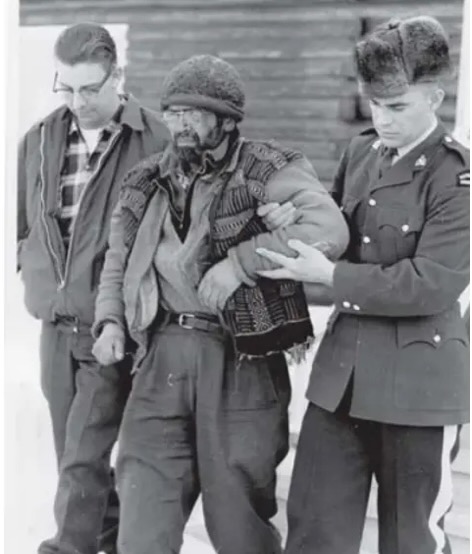
The body’s proteins contain more energy than their carbohydrates, but we can’t afford to burn much of it; the proteins are the molecular machinery of the body. Skeletal muscle protein can be burned, as it was for Ralph Flores and Helen Klaben (he could barely walk — that’s him in the picture at the top). But if a significant amount of protein in the vital organs is burned for energy, it’s soon game over.
By far the largest energy store in the body is fat. Fat has a high energy content per gram, and there’s little water associated with it, reducing its weight to energy ratio even more. (A gram of glycogen binds about 4 grams of water. It would take 300 pounds of hydrated glycogen to store the amount of energy that is held in a typical adult’s fat.) For an average person, fat can power survival for many weeks. It was fat that allowed Klaben and Flores to survive for 49 days in the sub-zero Canadian wilderness, although they both lost some protein as well.
The brain wants some sugar
Some tissue needs glucose to survive, and this presents a challenge for the starving person. For example, red blood cells. Although these cells carry oxygen around the body, they lack mitochondria, and so they spit out the product of their anaerobic glucose metabolism, which is lactate. However, this is not a great loss, because other tissues can convert that lactate back to glucose, or can burn the lactate to CO2 using oxygen-dependent metabolism.
The white blood cells, the leukocytes, also need glucose for energy. But they convert it to carbon dioxide through oxidative metabolism. So the glucose they use is lost to the system, and must be replenished each day.
The biggest problem is the brain. The human brain normally uses mostly glucose for energy because fats don’t easily penetrate the blood-brain barrier. Fortunately, the brain’s metabolism is adaptable. During starvation, when the blood glucose level drops, the brain reduces it glucose consumption to about 35% of normal. It begins to derive energy from another, fat-derived type of metabolite: ketone bodies, which are small, water-soluble molecules that can cross into the brain.
There’s fat, and then there are ketone bodies
Normally, fat is used for energy post-prandially (a fancy word which means, ‘after a meal’). Oxidative metabolism converts it to CO2, which generates bountiful energy.But there’s a hitch; fat oxidation, which takes place mainly in the mitochondria of cells, depends on carbohydrate-derived ‘primer’ metabolites (these are intermediates in the so-called ‘Krebs cycle’).
Fatty acids, the breakdown product of stored fat, enter the energy scheme by being clipped into short, water-soluble fragments. These combine with certain intermediates, ‘primers’, and enter oxidative energy metabolism. And that’s the major problem for a starving human: these ‘primers’ are derived from carbohydrate, and become scarce during carbohydrate deprivation. There is no metabolic pathway in humans to convert fat or its breakdown products into primers.
An expression my PhD supervisor used to quote was “Fat burns in the carbohydrate fire”. What happens when fat oxidation is impaired because of a shortage of carbohydrate-derived primer molecules? The short fatty acid breakdown products are then converted into the famous water-soluble ketone bodies.
The essential problem of starvation
Surviving starvation, then, depends on carbohydrate-derived ‘primer’ molecules. Where are these to come from in the absence of glucose in the diet? Part of the needed glucose is, in fact, produced by the breakdown of fatty acids. When a stored fat, a triglyceride, is used for energy production, three fatty acids are cleaved from a backbone of glycerol. Glycerol is a carbohydrate, and can be converted to glucose and other carbohydrates. So that’s part of the carbohydrate needed, but it’s not enough.
Instead, the carbohydrate needed for days and weeks of survival comes from an expensive source: the body’s proteins. During long term starvation, proteins begin to be broken down to their amino acids, some of which can be converted to glucose in the liver. (This is called gluconeogenesis — the generation of new carbohydrate). Mostly, the degraded protein comes from skeletal muscles, which aren’t as precious as organ proteins. We can live with weaker biceps, but a weakened heart may fail.
The result of the loss of protein during starvation is seen by the weight lost in excess of the fat that provides the required energy. Flores lost 51 pounds in total, despite his energy needs being met by about 20 pounds of fat.
Flores and Klaben survived for 49 days by not moving around a lot, by their brains adapting to use ketone bodies for energy, and by slowly converting some of their proteins to glucose. People can survive for weeks without food (but not without water), but eventually they die, usually not because they’ve run out of fat, but because of a lack of micronutrients and the loss of critical protein. Experts believe that death associated with starvation occurs when 30-50% of body proteins are depleted. Under the right circumstances, people have been known to survive 10 weeks, and more.
Medical examination indicated that Flores was days from death, Klaben perhaps a week or so.
How do we know about gluconeogenesis (the breakdown of proteins to produce glucose)?
The 19th century French physiologist Claude Bernard was the first person to envisage gluconeogenesis, the conversion of protein to glucose inside a mammal. In his seminal book ‘Introduction to the Study of Experimental Medicine’, published in 1865 and still read by students of the history of Science, he described how he came to suspect this process. In the English translation, Bernard’s description begins…
“One day, rabbits from the market were brought into my laboratory. They were put on the table, where they urinated, and I happened to observe that their urine was clear and acid. This fact struck me, because rabbits, which are herbivora, generally have turbid and alkaline urine; while on the other hand carnivora, as we know, have clear and acid urine. This observation of acidity in the rabbits’ urine gave me an idea that these animals must be in the nutritional condition of carnivora. I assume that they had probably not eaten for a long time, and that they had been transformed by fasting into veritable carnivorous animals, living on their own blood. Nothing was easier than to verify this preconceived idea or hypothesis by experiment…”
My students always laughed when I read this narrative to them. But it made the point, both about gluconeogenesis (the rabbits were consuming their body protein during a fast to make glucose) and how creative science gets done. Since then we have figured out every step of the way this happens.
So what happens if I don’t eat for 48 hours?
Short-term starvation, or fasting, is different. The brain does little adapting during a few days of food deprivation, and its need for glucose continues. Because dietary carbohydrate is missing, gluconeogenesis kicks in. And because of a relative deficit in carbohydrate-derived metabolites, ketone bodies build up. The fasting person may feel a little light-headed, but the fasting state can also be one of heightened intellectual awareness and energized activity.
From what I’ve said, you might guess that low-carbohydrate diets, like Atkins, have a similar effect, and you’d be right. There is a rise in ketone bodies during low-carbohydrate dieting, but the reasons for the weight loss often seen are complicated: there’s water loss initially, and there’s loss of appetite, and there’s some loss of ketone bodies through the kidneys.
Grizzlies can bear world-record starvation
It’s a bit of a misnomer to call the hibernation of bears ‘starvation’, although they do go many months without food. According to bear researcher Brian Barnes of the University of Alaska in Fairbanks, they go into the cave, turn around two or three times, lie down, and stay that way for six months. During this time, mother bears can deliver babies and nurse them, all the while eating nothing. They only get up to switch sides every few days.
Hibernating bears, like starving humans, are living on their fat stores. They may lose 30-40% of their body weight, essentially all of it fat. But while humans have to sacrifice some body protein to keep fat burning and life going, bears don’t. Bears often do not urinate or defecate for 6 months, and no nitrogen is lost (nitrogen would be produced during the conversion of amino acids to glucose). So, there’s no breakdown of proteins to feed gluconeogenesis.
It all comes down to, as Winnie the Pooh regretfully admittted, the bear is of little brain. It’s the big brain of humans, with its insistence on getting sugar, that drives gluconeogenesis. The bear, with a lower brain to body ratio, can manage on just the glycerol that is produced by the breakdown of triglycerides to fatty acids and glycerol. And the amount of fat they actually have to burn up is minimized by the lovely bearskin coats they wear.